Short answer: The main Bubble alternatives in 2026 are Lovable (React web apps with code you can sync to GitHub), Replit (browser IDE with an agent), Bolt.new (fast prototypes in the browser), v0 (Next.js apps on Vercel), Emergent (full-stack web and mobile apps by chat) and Devfab (an AI software factory that plans, builds, tests and deploys to your own server). The biggest difference from Bubble: most of these give you the source code.
What Bubble does well
Bubble is a visual platform for building web apps without writing code. You design pages element by element, define your database inside Bubble, build logic with workflows, and host the app on Bubble's infrastructure. It has added AI tools that help you start a build, and it gives more design control than most no-code tools. Reviewers rate it highly for custom B2B products with complex workflows.
Why teams look for alternatives
- No source-code export. Reviewers consistently report that leaving Bubble means rebuilding the app elsewhere.
- Usage-based hosting costs. Bubble bills by workload units, which measure the server resources your app uses. Teams find these hard to forecast before the app is built and live.
- Learning curve. Mastering the editor, database logic, privacy rules and performance takes time.
- Data in your own systems. If your data already lives in your own database or internal APIs, you have to duplicate or migrate it into Bubble.
- Engineering handover. When a product grows, teams often want developers working in a normal codebase with normal tools.
How we compared
We compared each tool on what it's built for, using vendor pages and independent reviews as of November 2026. For each tool we looked at code ownership, hosting, pricing model, and what it covers after the first version: testing, deployment choice, documentation and maintenance. We describe pricing models rather than prices, because prices change often.
Shortlist with a feature table
| Tool | Best for | You get the code? | Hosting | Pricing model |
|---|---|---|---|---|
| Bubble (baseline) | Visual no-code web apps | No export | Bubble | Plans + workload units |
| Lovable | Polished React web apps | Yes, GitHub sync | Supabase + one-click deploy | Credits per message |
| Replit | Browser IDE with an agent | Yes | Replit deployments | Effort-based |
| Bolt.new | Fast prototypes | Yes, export | Bolt Cloud or Supabase | Tokens |
| v0 | Next.js teams on Vercel | Yes, Git with PRs | Vercel | Tokens |
| Emergent | Full-stack web + mobile by chat | Yes, GitHub sync | Built-in hosting | Credits |
| Devfab | Planned, tested delivery for teams | Yes, in your GitHub from day one | Your own server | Cost logged per task and project |
Lovable
Generates React and TypeScript web apps from a prompt, with Supabase for the database and sign-in, and GitHub sync. Best for non-technical founders who want polished, portable web apps. Limits: web apps only; credits are charged per message, including fixes.
Replit
A browser IDE with an autonomous agent, 50+ languages, a built-in database and managed deployments. Best for teams that want to see and edit every line. Limits: effort-based pricing can be hard to predict; the full IDE can overwhelm non-technical users.
Bolt.new
Runs a full Node.js environment in the browser, with Bolt Cloud for databases, auth and hosting. Best for fast prompt-to-prototype iteration. Limits: token-based pricing; default designs can look generic.
v0
Vercel's builder for Next.js apps, with Git branches, pull requests and one-click deploy to Vercel. Best for teams already on Vercel with at least one engineer. Limits: strongly tied to the Vercel ecosystem.
Emergent
Builds full-stack web and mobile apps by chat, with built-in hosting, GitHub sync and many ready integrations. Best for non-technical builders who want a live app fast. Limits: credits can run down quickly while debugging.
Where Bubble is still the better choice
- You want pixel-level visual control without touching code.
- Your app is a custom B2B tool with complex workflows and modest traffic.
- You're happy to stay on one platform and don't need to hand code to developers.
- Your team has already invested in learning Bubble.
Where Devfab fits
Devfab is an AI software factory. Instead of a visual editor, you describe the app, and a team of agents runs the lifecycle around it.
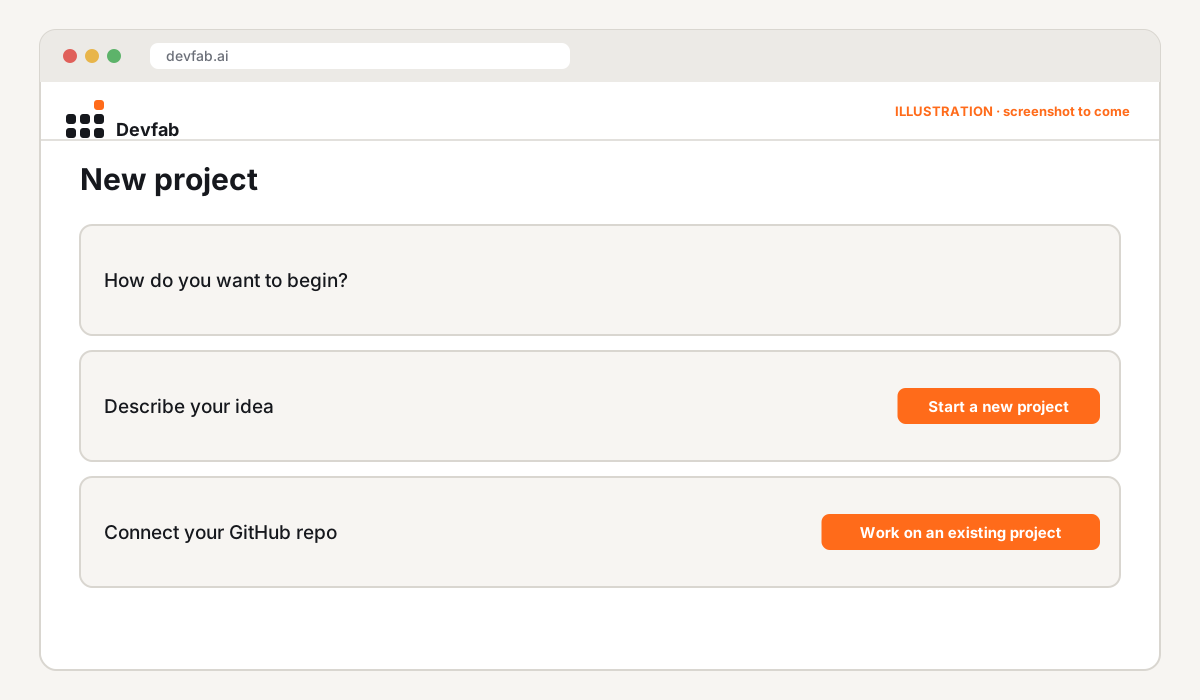
- Describe the app in plain language, or attach a spec. Choosing a technology is optional; Devfab picks a stack that fits.
- Choose how closely to steer it: Human in the loop (you approve each stage) or Auto.
- Approve the plan the Planner writes before any code exists.
- Agents build and test: a Coordinator assigns tickets to developer agents, and a QA agent reviews each ticket before it's done.
- Your code, your server: the repository lives in your own GitHub account or organisation, and apps deploy to your own server.
- Keep improving: connect an existing repo too, and turn user feedback into tickets.
Where others are better: Devfab is not a visual drag-and-drop editor. If you want to design every pixel yourself, Bubble is stronger. Devfab is also new, in Beta, with a smaller community.
How to choose
- Visual control, no code, one platform? Stay with Bubble.
- Polished web app you can take with you? Lovable.
- See and edit all the code in the browser? Replit.
- Fast prototypes? Bolt.new.
- On Vercel and Next.js? v0.
- Web and mobile by chat with hosting included? Emergent.
- Production apps for clients or your business, tested and on your own servers? Devfab.
FAQ
Can I export my code from Bubble?
No. Bubble doesn't offer source-code export, so moving to another platform means rebuilding the app. If code ownership matters, choose a tool that writes to your own repository.
What is the best free Bubble alternative?
Most alternatives have a free tier or trial, including Lovable, Replit, Bolt.new and v0. Free limits change often, so check each vendor's pricing page.
Is Bubble good for production apps?
Yes, for many B2B tools with modest traffic. Teams that expect high traffic, need predictable hosting costs or want a normal codebase for developers often choose a code-based alternative.
Which Bubble alternative is best for agencies?
Agencies usually need code they can hand to clients, a plan clients can approve, test evidence and deployment to the client's infrastructure. An AI software factory like Devfab is built for that.
Read next
- What is an AI software factory?
- Emergent alternatives for teams that ship to production
- Prototype vs MVP vs production app
Own your code from day one. Join the Devfab Beta.
Sources (checked November 2026): Jet Admin: Bubble review (published by a competitor); Altar.io: Lovable vs Bolt vs v0 vs Replit vs Base44; Emergent.
Frequently asked questions
Can I export my code from Bubble?
No. Bubble doesn't offer source-code export, so moving to another platform means rebuilding the app. If code ownership matters, choose a tool that writes to your own repository.
What is the best free Bubble alternative?
Most alternatives have a free tier or trial, including Lovable, Replit, Bolt.new and v0. Free limits change often, so check each vendor's pricing page.
Is Bubble good for production apps?
Yes, for many B2B tools with modest traffic. Teams that expect high traffic, need predictable hosting costs or want a normal codebase for developers often choose a code-based alternative.
Which Bubble alternative is best for agencies?
Agencies usually need code they can hand to clients, a plan clients can approve, test evidence and deployment to the client's infrastructure. An AI software factory like Devfab is built for that.