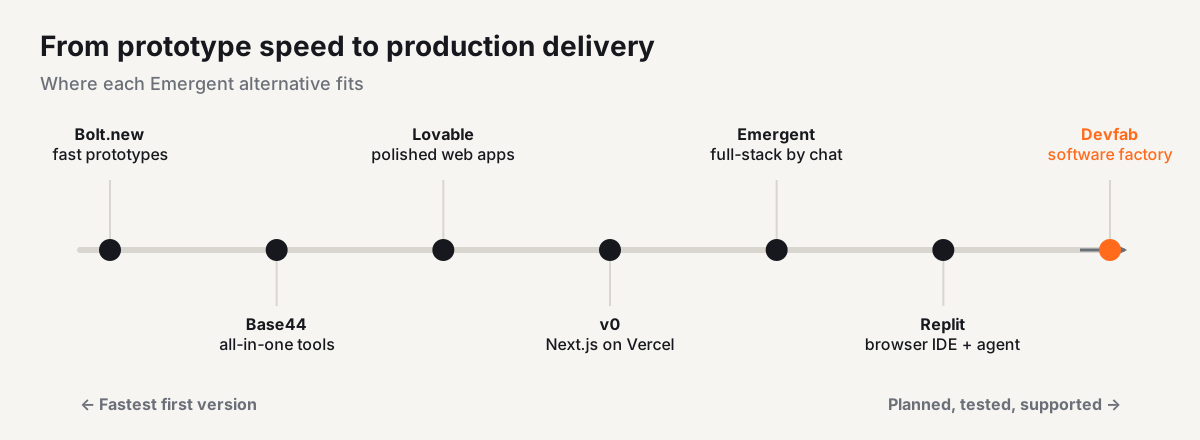
Short answer: The main Emergent alternatives are Lovable (polished web apps), Bolt.new (fast in-browser prototyping), Replit (browser IDE with an autonomous agent), v0 (Next.js apps on Vercel), Base44 (all-in-one internal tools) and Devfab (an AI software factory for planned, tested delivery). If your app has to be tested, deployed to your own servers and maintained for real users, look beyond prompt-to-app speed.
What Emergent does well
Emergent (emergent.sh) turns a plain-language description into a full-stack app: frontend, backend, database, authentication, APIs and deployment. You build by chatting with agents that design, code and deploy. It supports web and mobile apps from the same workspace, offers built-in hosting, syncs with GitHub, and includes many ready integrations such as payments, sign-in and email. Pricing is credit-based, with every AI action drawing from a monthly allowance.
Why teams look for alternatives
Emergent is a strong builder. Teams that look elsewhere usually mention one of these:
- Credit costs are hard to predict. Reviews note that debugging can use credits quickly, and keeping an app live also uses credits.
- Hosting on the builder's platform. Some teams, especially agencies and public-sector clients, need apps on their own servers.
- Complex apps still need testing and review. Reviewers note that larger apps need manual testing and code review before real users rely on them.
- Team and client delivery. Agencies need a plan the client signs off, test evidence, documentation and cost tracking per project.
How we compared
We compared each tool on what it's built for, using vendor product pages and independent reviews as of November 2026. For each tool we looked at:
- who it's built for and what it produces
- backend and hosting approach
- whether you can sync or export code to GitHub
- what it covers beyond the first version: plan approval, testing, deployment choice, documentation and maintenance
Pricing changes often, so we describe how each tool charges rather than quoting prices. Check vendor pricing pages before deciding.
Shortlist with a feature table
| Tool | Best for | Backend and hosting | Code to GitHub | Pricing model |
|---|---|---|---|---|
| Emergent (baseline) | Full-stack web and mobile apps by chat | Built-in hosting | Yes (sync) | Credits |
| Lovable | Polished React web apps | Supabase, one-click deploy | Yes (sync) | Credits per message |
| Bolt.new | Fast prototypes in the browser | Bolt Cloud or Supabase | Yes (export) | Tokens |
| Replit | Browser IDE with an agent, 50+ languages | Built-in database and deployments | Yes | Effort-based |
| v0 | Next.js apps for Vercel teams | Vercel | Yes (Git panel, PRs) | Tokens |
| Base44 | Simple internal tools, all in one | Base44's own platform | Limited | Credits |
| Devfab | Planned, tested delivery for teams | Deploys to your own server | Yes, in your own account from the start | Cost logged per task and project |
Lovable
What it is: An AI builder that generates React and TypeScript web apps, with Supabase for the database and authentication.
Best for: Non-technical founders who want polished, portable web apps.
Limits: Web apps only. Credits are charged per message, including prompts that fix earlier mistakes.
Bolt.new
What it is: StackBlitz's tool that runs a full Node.js environment in the browser, with Bolt Cloud for databases, auth and hosting, and mobile apps through Expo.
Best for: Fast prompt-to-prototype iteration.
Limits: Token-based pricing makes costs hard to predict, and the default design can look generic.
Replit
What it is: A browser-based IDE with an autonomous agent that can run long sessions, support for 50+ languages, a built-in database and managed deployments.
Best for: Technically curious founders and teams who want to see and edit all the code.
Limits: Effort-based pricing can be hard to predict, and the full IDE can overwhelm non-technical users.
v0
What it is: Vercel's builder for Next.js apps with shadcn/ui and Tailwind, with Git branches, pull requests and one-click deploy to Vercel.
Best for: Teams already on Vercel and Next.js, with at least one engineer.
Limits: Strongly tied to the Vercel ecosystem; full-stack features are newer.
Base44
What it is: An all-in-one platform, owned by Wix, that builds and hosts apps with no setup.
Best for: Beginners building internal tools they don't plan to move.
Limits: Apps run on Base44's own platform and code export is limited, so moving later means rebuilding.
Where Emergent is still the better choice
Stay with Emergent if:
- You want web and mobile apps from one workspace, built by chatting.
- You want hosting handled for you, with SSL and environment setup done automatically.
- You need many ready integrations (payments, sign-in, email, SMS, storage) without setting them up.
- You're non-technical and want the shortest path from idea to a live app.
Where Devfab fits
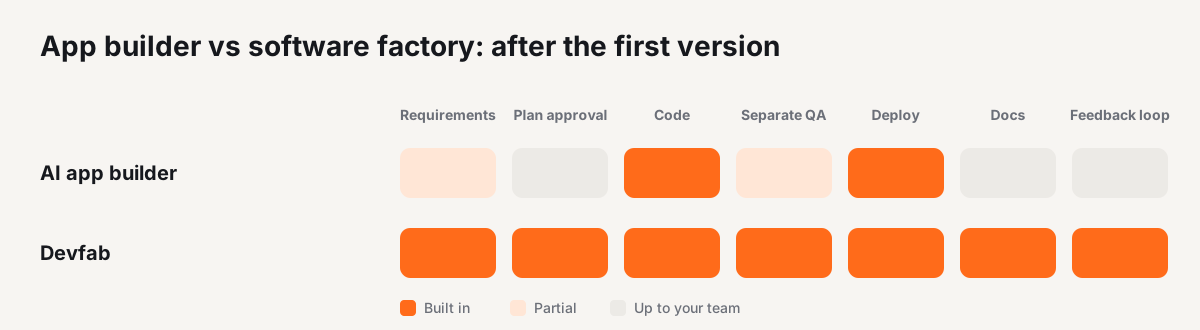
Devfab is an AI software factory, not an app builder. App builders are built to get a first version on screen. Devfab is built for the whole lifecycle around it: from idea to shipped, supported software.
- Start from one sentence or a full requirements document. A research agent can expand a short idea into a spec.
- Approve the plan first. A planner agent writes the implementation plan, and a person approves or edits it before code is written.
- Agents work as a team. A coordinator assigns tickets to dev agents on a built-in task board; there's no fixed limit on dev agents.
- Separate testing. A QA agent runs unit, logic, flow and UI tests on each task.
- Your GitHub, your server. Code is in your own GitHub account from the start, and apps deploy to your own server.
- Documents included. Blueprints, hi-fi designs, sequence flows, prototypes and user manuals.
- Built for maintenance. Connect an existing product and keep improving it. User feedback becomes tickets, and the reporter is told when the fix ships.
- Predictable cost. Cost is logged after each run, per task and per project.
Where others are better: If you want a live app in minutes with hosting handled for you, Emergent, Lovable or Bolt.new are faster. Devfab asks you to review a plan before building, which takes a few minutes more. It requires connecting a GitHub account, and as a Beta product it has fewer ready-made integrations and a smaller community.
Who it suits: agencies, outsourcing firms and businesses that need apps tested, documented and running on their own infrastructure, and teams that have outgrown a prototype.
How to choose
- Non-technical, want a live web or mobile app fast? Emergent or Lovable.
- Prototyping ideas quickly? Bolt.new.
- Want to see and edit all the code in the browser? Replit.
- On Vercel and Next.js? v0.
- Simple internal tool, no plans to move? Base44.
- Delivering production apps for clients or your own business, with testing, docs and your own hosting? Devfab.
FAQ
What is Emergent?
Emergent (emergent.sh) is an AI app builder that turns a plain-language description into full-stack web and mobile apps, with agents that design, code and deploy, built-in hosting, GitHub integration and a credit-based pricing model.
What is the best Emergent alternative?
For polished web apps from a prompt, Lovable. For fast in-browser prototyping, Bolt.new. For a full browser IDE with an agent and many languages, Replit. For Next.js teams on Vercel, v0. For the simplest all-in-one internal tools, Base44. For teams that need plan sign-off, separate testing, deployment to their own servers and documentation, an AI software factory like Devfab.
Why do teams move away from AI app builders?
Common reasons are hard-to-predict credit costs during debugging, hosting tied to the builder's platform, and the extra work needed to test, document and maintain an app once real users depend on it.
Can I keep my code if I leave an AI app builder?
It depends on the tool. Several, including Emergent, Lovable and Replit, support syncing or exporting code to GitHub. Some all-in-one platforms limit export, which makes moving harder. Check this before you build anything important.
Read next
- What is an AI software factory?
- Prototype vs MVP vs production app: what's the difference
- How AI agents handle bug reports from customers
Take your app past the prototype. Join the Devfab Beta.
Sources (checked November 2026): Emergent; Geekflare: Emergent review; Altar.io: Lovable vs Bolt vs v0 vs Replit Agent vs Base44.
Frequently asked questions
What is Emergent?
Emergent (emergent.sh) is an AI app builder that turns a plain-language description into full-stack web and mobile apps, with agents that design, code and deploy, built-in hosting, GitHub integration and a credit-based pricing model.
What is the best Emergent alternative?
For polished web apps from a prompt, Lovable. For fast in-browser prototyping, Bolt.new. For a full browser IDE with an agent and many languages, Replit. For Next.js teams on Vercel, v0. For the simplest all-in-one internal tools, Base44. For teams that need plan sign-off, separate testing, deployment to their own servers and documentation, an AI software factory like Devfab.
Why do teams move away from AI app builders?
Common reasons are hard-to-predict credit costs during debugging, hosting tied to the builder's platform, and the extra work needed to test, document and maintain an app once real users depend on it.
Can I keep my code if I leave an AI app builder?
It depends on the tool. Several, including Emergent, Lovable and Replit, support syncing or exporting code to GitHub. Some all-in-one platforms limit export, which makes moving harder. Check this before you build anything important.